

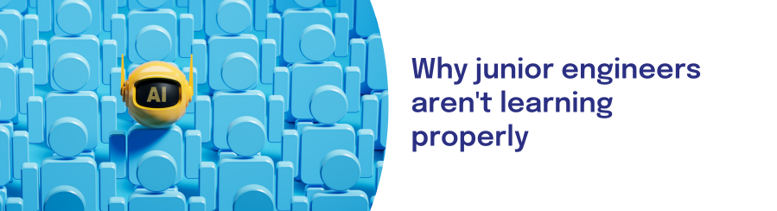
Why junior engineers aren't learning properly
It's never been easier to get the right answer. However, what happens when we stop learning how to ask the right question?
Across development and testing teams, we're racing to integrate AI without discussing an uncomfortable truth: we might be creating a generation of engineers who've never learned to think critically about the problems they're solving.
Today's early-career professionals have incredible tools at their disposal - AI that debugs in seconds, suggests test cases and fixes code faster than any senior engineer could manage. It looks like a productivity revolution. However, having worked with hundreds of technology programmes, I'm watching something vital disappear: the ability to develop genuine engineering judgement.
The learning that never happens
Think back to your early career. Remember staying late to debug that impossible issue? The satisfaction when you finally cracked why tests kept failing randomly? Those weren't just problems to solve; they were your education.
Real engineering capability grows from struggle. From investigating strange failures that make no sense. From that moment when you realise the "obvious" fix actually makes things worse. These experiences teach you to question everything, to dig deeper and to never accept solutions at face value.
When AI handles these moments automatically, junior engineers miss their chance to develop these instincts. They get answers without understanding the questions. They implement fixes without grasping why things broke. The learning curve doesn't just flatten - it disappears entirely.
Your team's own dead internet problem
You might have heard of the "Dead Internet Theory", which imagines the web as a place where bots mostly talk to other bots, generating an endless loop of self-referential content. A similar dynamic can emerge when AI models are trained on AI-generated data: the system starts learning from faint reflections of its own output, creating a feedback loop that can degrade quality over time.
Avoiding that kind of downward spiral means keeping an eye on what goes into the data source, being clear about where the data comes from, and making sure there’s always plenty of fresh, human-generated material in the loop.
Here's how it unfolds: AI provides solutions, juniors accept them without question, they never develop deeper understanding, and eventually they're training tomorrow's tools with increasingly limited knowledge. It's a downward spiral where each generation knows less about the fundamentals than the last.
In quality assurance, missing bugs isn’t the be all and end all. It's about developing blind spots so systematic that nobody even knows they exist. When you're working in financial services or government systems, these blind spots are inefficient but more crucially, They're genuinely dangerous.
What you're really losing
The immediate risks are obvious enough. Edge cases slip through because nobody thought to check them. Teams become overconfident in AI-suggested solutions without understanding their limitations. Test results get misinterpreted because nobody has the context to spot what's actually wrong.
However, here's what keeps me awake: we're building the future leadership of every major transformation programme in the country. If that leadership grows up accepting AI outputs without question, who's going to spot problems when they really matter?
Your senior engineers won't be around forever. The juniors accepting AI solutions today will be making critical decisions tomorrow. If they've never learned to think critically about those decisions, your entire delivery capability becomes fragile.
Building better foundations
This doesn’t mean rejecting AI or turning back the clock. It's about being intentional with how we develop talent alongside technology.
Smart organisations are already adapting. They're pairing AI assistance with senior mentorship that explains what AI suggests, but why it might be wrong. They're treating debugging sessions as learning opportunities rather than productivity obstacles.
Most importantly, they're teaching junior engineers to challenge AI outputs the same way they'd challenge any other assumption - to ask: "why did it suggest this?" and "what might it have missed?" rather than simply accepting the answer.
Your next move?
If you're running technology programmes, you need to act now - not to limit AI adoption but to ensure your teams develop alongside it. Create structured learning paths that build fundamental understanding before introducing AI assistance. Celebrate the engineers who spot when AI gets it wrong, not just those who implement its suggestions fastest.
Remember, the tools are meant to amplify human capability, not replace the need to develop it. Your competitive advantage won't come from having the best AI. It'll come from having engineers who know when not to trust it and what to do when it goes down.
Whilst AI can give you answers instantly, only humans who've struggled through the problems can ask the questions that matter and do the work. In our rush to be efficient, we can't afford to lose that.