
How specialist testing and automation supported Costa Coffee's loyalty app, accelerating regression testing, reducing delivery costs and building confidence at scale.

The results at a glance
Modernising the loyalty experience for millions of customers
Costa Coffee's Coffee Club loyalty programme had been an important part of its customer engagement strategy since its introduction in March 2010, enabling customers to earn rewards through purchases and strengthening customer relationships.
In August 2014, Costa Coffee introduced the Coffee Club app for iOS and Android, allowing customers to access their loyalty accounts, check points balances and manage their membership digitally. By 2018, the app had attracted approximately 1.3 million downloads. However, as customer expectations evolved and competing loyalty apps introduced more sophisticated features, the existing experience was becoming increasingly limited.
Costa Coffee recognised the opportunity to modernise the app, improve usability and introduce new functionality that would make the loyalty programme more convenient and engaging, embarking on a major redesign that would support existing members while attracting new users.
The challenge went beyond the app itself. The new platform needed to work reliably across iOS and Android devices, integrate with existing loyalty, payment and retail systems, and perform consistently during periods of high customer demand. With an ambitious launch timeline and limited internal testing capacity, Costa Coffee needed a comprehensive quality assurance approach that could support rapid delivery without compromising the customer experience.
The challenge was to introduce new digital capabilities at speed while maintaining the reliability, performance and consistency customers expected from Costa Coffee.
Embedding quality across the digital experience
The new Coffee Club app needed to be tested against an ambitious launch timeline, with a strategy that was both time-efficient and cost-effective. Existing knowledge of Costa Coffee's business processes and systems helped support the continuous delivery of the app.
Functional testing across devices
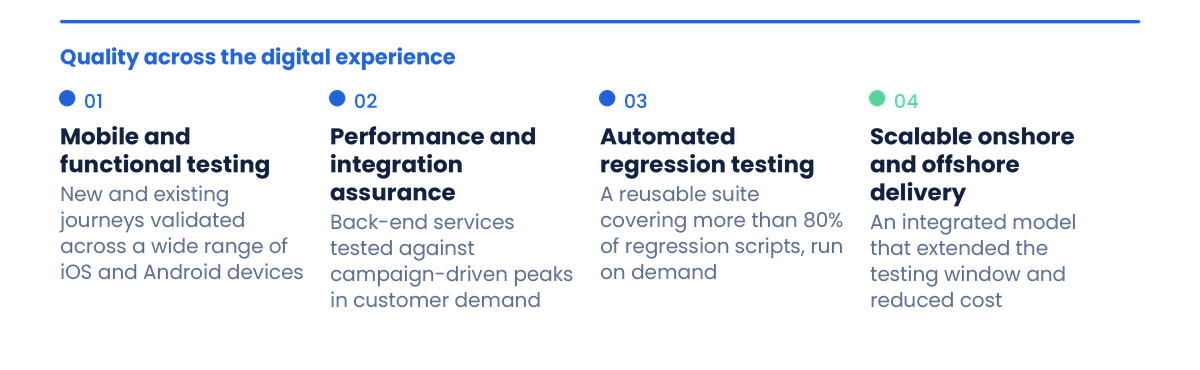
Functional testing was carried out across the new features and redesigned app interface using a wide range of iOS and Android devices, helping ensure customers could access a consistent experience regardless of their chosen platform. Testing also validated existing functionality, including account registration, loyalty points, store information and integration with Costa Coffee's wider digital services.
Performance and back-end integration
The engagement extended beyond the mobile interface. Performance testing assessed how the app and its integrated back-end services would respond to different usage scenarios, including periods of increased demand generated by campaigns and promotions.
Automated regression testing
A key priority was reducing the time required to complete regression testing without sacrificing coverage. A reusable automation suite was developed to validate existing functionality following changes, with tests executed ahead of the working day or immediately after development changes.
Over time the automation approach achieved more than 80% regression script coverage, providing a more efficient foundation for ongoing app development.
Onshore and offshore delivery
The testing approach combined onshore specialists with an offshore delivery team, creating a scalable model that could respond to changing project demands and maintain momentum against demanding release schedules. Combining the two extended the testing window by 30% while reducing testing costs.
Testing the complete customer experience
Testing spanned the app itself and the wider estate supporting the loyalty programme, from customer-facing journeys through to payments, retail systems and reporting.
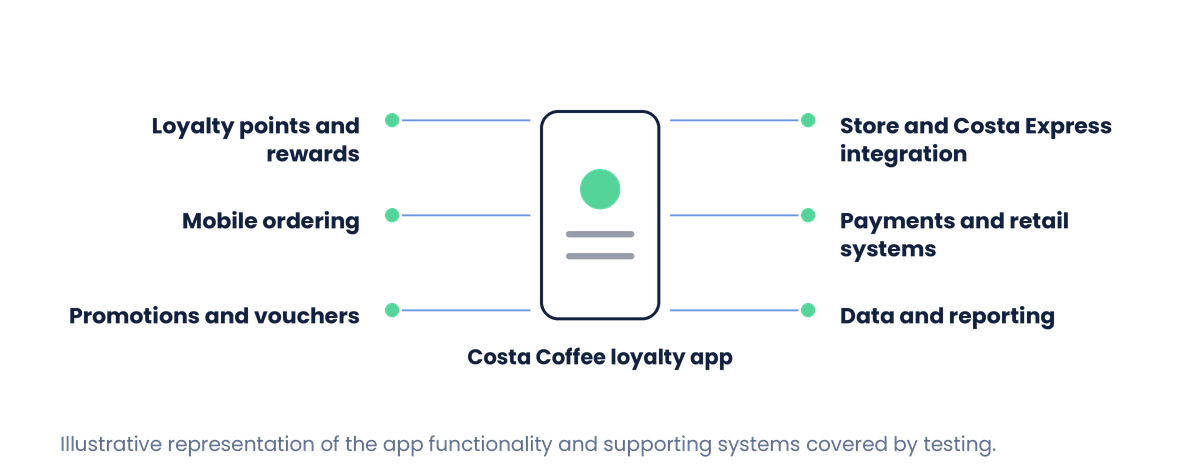
Illustrative representation of the app functionality and supporting systems covered by testing.
Financial reporting and data validation
A structured approach to financial report testing increased the detail used to interrogate data before business validation, identifying defects earlier and streamlining sign-off.
Faster testing, lower costs, greater confidence
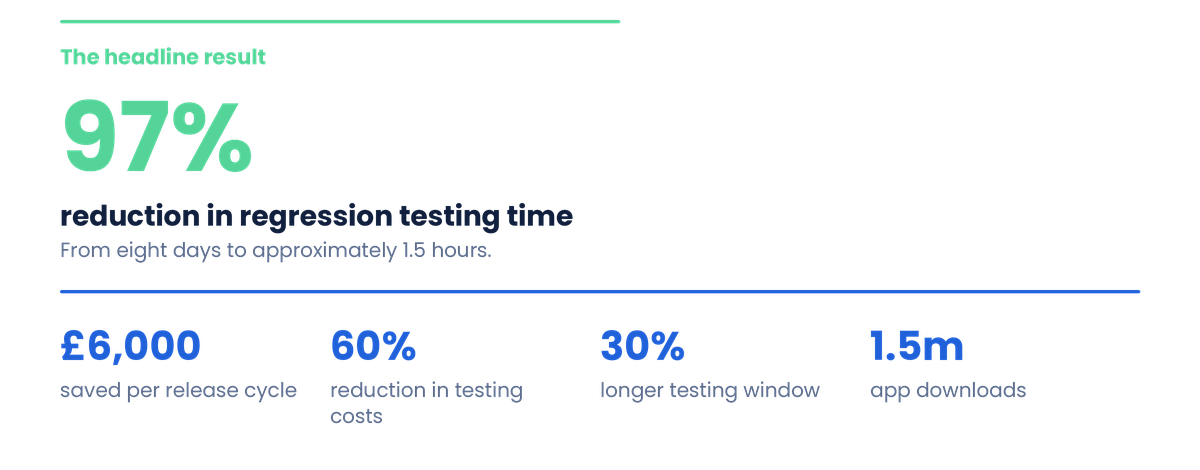
Automation transformed regression testing, reducing validation time from eight days to approximately 1.5 hours and enabling significantly faster testing of application changes.
This reduced the effort required for repeat testing and supported more frequent delivery as functionality continued to evolve.
- £6,000 saved per release cycle. Reusable automation reduced repeat testing costs.
- 60% testing cost savings. Offshore delivery improved efficiency.
- 30% longer testing window. Integrated teams extended testing capacity.
- 1.5 million app downloads. The relaunch achieved significant adoption.
Prepared for exceptional promotional demand
The app supported a major three-day birthday promotion that generated significant customer activity. Performance testing helped prepare the app and its supporting systems for periods of exceptionally high demand.
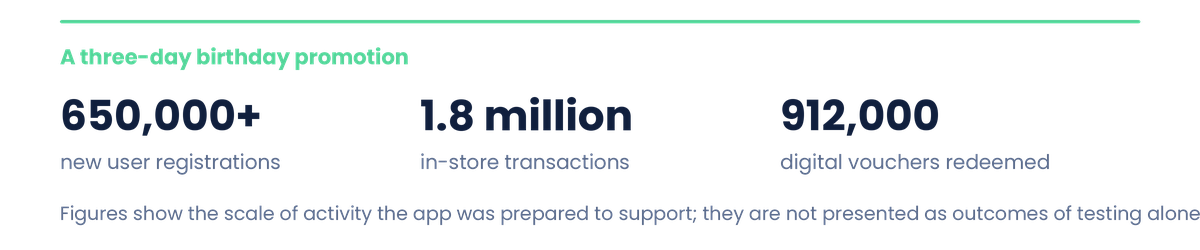
These figures demonstrate the scale of activity the app was prepared to support; they are not presented as outcomes of testing alone.
Supporting evolving customer needs
Ongoing testing support was also provided for app updates, including during the COVID-19 pandemic, covering functionality designed to reduce physical contact, such as contactless ordering through Costa Express machines and ordering from café tables.
A more responsive approach to delivery
By validating customer-facing functionality alongside supporting integrations, reporting processes and back-end systems, the engagement helped Costa Coffee introduce new services with greater confidence.
Read the full case study
The complete case study covers the challenge, the testing approach, the systems in scope and the outcomes in full.
Deliver change with confidence
Discover how 2i can support your next technology programme.