


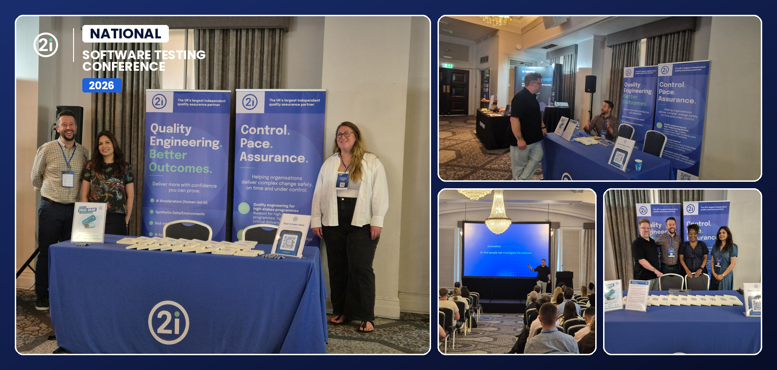
Attending the National Software Testing Conference (NSTC) for the first time gave me a real insight into the conversations shaping software quality today. While AI featured heavily throughout the event, what stood out most wasn't the technology itself. It was the shared challenge of delivering change quickly without losing sight of quality.
From the moment registration opened, the venue was buzzing with testers, QA leaders, engineering managers, consultants and technology specialists, all keen to share experiences and discuss what they're seeing in their own organisations. Whether in conference sessions or around the exhibition floor, many of the same themes kept emerging: balancing speed with quality, adopting AI responsibly and making sure quality keeps pace with increasingly complex delivery.
For me, the event was also significant for another reason. Having recently joined 2i as part of the Planit UK acquisition, it gave me the opportunity to spend time with some of my new colleagues, including Ryan James, Samer Naqvi and David Williams. Seeing the energy, expertise and passion they brought to discussions throughout the day left me feeling genuinely excited about what this next chapter looks like and reinforced my belief that there's a bright future ahead as part of the wider 2i team.
One of the highlights of the conference was 2i's own David Williams presenting From Thatch to Tile: Why Your Testing Approach is a Roofing Problem. On paper, roofing might seem an unusual way to explain quality engineering, but the analogy quickly proved its value. David challenged the assumption that when a new practice emerges, the new automatically replaces the old. Instead, exploratory testing hasn't disappeared; it has simply become more specialised, much like traditional thatching.
That really resonated with me because it reflects what many teams are experiencing. We've seen the move from waterfall to agile, from manual testing to automation, and now to AI-assisted delivery. The organisations making the biggest progress aren't replacing one approach with another. They're combining different approaches to suit the problem they're trying to solve.
One insight in particular stayed with me:
"Automation protects the known so that people can investigate the unknown."
It was a simple statement, but it sparked plenty of discussion throughout the day. Conversations at the 2i stand often came back to familiar challenges around automation, delivery pressures, organisational silos and competing priorities. What stood out was that these weren't always technical problems. More often, they came down to people, processes and how organisations make decisions during change.
AI was another topic that surfaced throughout the conference. Interestingly, the discussion has already moved beyond the excitement of adoption. The focus now seems to be on proving value, putting the right governance in place and understanding how quality evolves as AI becomes part of everyday software delivery.
The consensus was reassuring. Testers and quality professionals aren't becoming less important—they're becoming more important in different ways. Critical thinking, investigation, risk management and good judgement are becoming just as valuable as technical skills.
Another session that stood out was Ansuman Swain's Designing a Future-Ready Test Practice: From Vision to Value. His message was straightforward: before investing in tools or launching transformation programmes, take the time to define what quality actually means for your organisation.
His advice to "design the practice before you scale it" was one of the day's simplest but most memorable messages.
That question: "What does quality mean to you and your stakeholders?", stayed with me long after the session ended. It sounds obvious, but judging by the conversations throughout the conference, it's something many organisations still wrestle with. It's easy to focus on automation, tooling and delivery speed before agreeing what success actually looks like.
What struck me most was how closely the conference sessions reflected the conversations happening around the exhibition floor. Regardless of the technology or industry, people were talking about many of the same challenges: delivering change faster, keeping quality high and giving teams confidence in the decisions they make before releasing software.
My biggest personal takeaway, however, didn't come from a keynote session.
It came when someone walked up to the 2i stand while I was on my own and asked:
"What do 2i do?"
For a brief second, I froze.
Then it hit me - I wasn't attending NSTC as an observer anymore. I was representing 2i.
I found myself talking about the kinds of challenges we'd been discussing all day: helping organisations deliver complex technology change while maintaining quality and keeping critical services running. Looking back, it was a small moment, but an important one. It was probably the first time it truly registered that I was part of the 2i team.
That moment summed up the conference for me. Beyond the discussions around AI, automation and transformation, I came away with a clearer picture of where the industry is heading and the role quality continues to play in successful delivery.
As David Williams concluded in his session:
"That's what quality looks like when it's built for where software delivery is going, not where it's been."
After everything I heard and the conversations I had, that message feels more relevant than ever.